Solar energy has emerged as one of the most sensible investments to make in the face of rising electricity costs and increasing knowledge about renewable sources of energy. If one aims to save money from monthly electricity costs, gain freedom from energy providers, or simply live a greener life, using solar energy would provide many benefits beyond saving money.
But among the many decisions an Indian homeowner needs to make when investing in solar power, perhaps one of the most important ones would be determining which kind of solar system one needs. While some would focus on the solar panels' capacity and cost, what kind of system one decides to get would affect how much money he or she could save, how accessible he or she would have to the solar power, the maintenance involved, and his or her investment's returns.
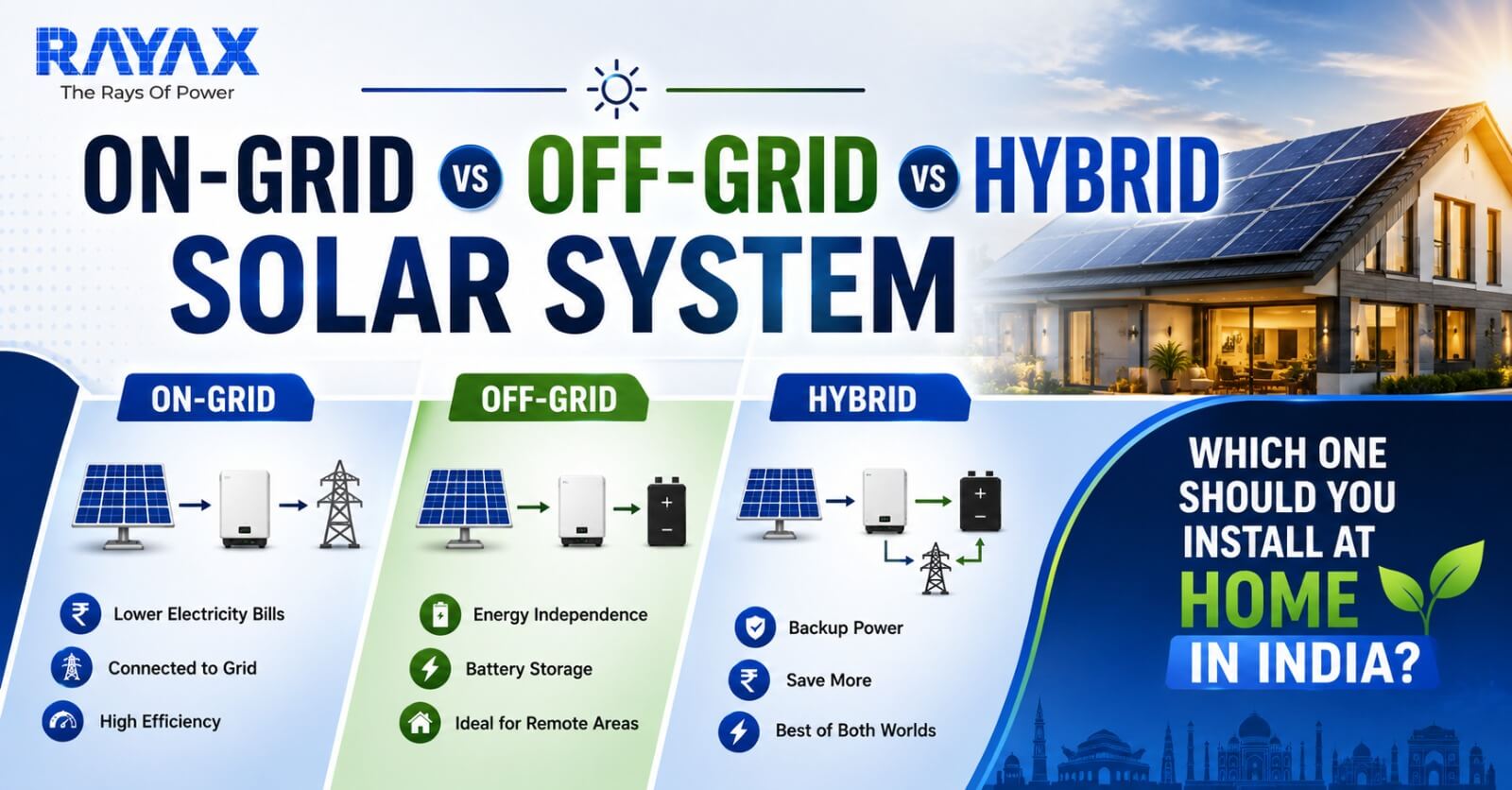
Here are three common types of solar systems:
- On-grid Solar Systems
- Off-grid Solar Systems
- Hybrid Solar Systems
Why Choosing the Right Solar System Matters
Installing a solar system does not just mean producing electricity. This process involves designing an energy solution that meets your domestic needs depending on your electricity consumption patterns, your residential location, and future needs.
For instance, a person who resides in a place where electricity is readily available will focus on saving on electricity bills, whereas another residing in a place experiencing power outages will prefer an unending source of power compared to savings only.
Choosing the wrong solar system may result in:
- Higher costs for the installation
- Insufficient battery power
- Less profit from the venture
- Unexploited generation capacity
- Cost of upgrading in the future
A comprehensive assessment of your energy needs prior to installation will ensure efficiency and profitability.
Understanding the Difference Between On-Grid, Off-Grid and Hybrid Systems
Essentially, every solar system uses light energy from the sun to generate electricity. The main distinction, however, is in their capacity to handle any excess power generated and their dependence on the grid.
Some systems return the excess power to the grid, while others use battery power storage. Some incorporate a combination of both options. Each design has its advantages and disadvantages.
Understanding how each solar system works can help you choose the one that would work best for your home.
What is an On-Grid Solar System?
A grid-tied solar energy system is tied to the electrical grid. Solar panels create electricity during daytime, and this electricity is used for powering various devices at home. The surplus of electricity that the system creates and the house does not use is often exported to the grid using net metering systems.
During periods when there is little or no production from solar panels, the house will draw electricity from the grid seamlessly. This means that the user does not need batteries or any other storage facility.
Key Characteristics of On-Grid Systems
- Grid-connected
- Doesn’t use any battery
- Compatible with net metering in some regions
- Lower installation costs compared to battery systems
- Best for places where there is stable access to electricity
As batteries aren’t required by these systems, they can be said to be the most economical choice.
Advantages of On-Grid Solar Systems
Affordability and efficiency have been one of the main causes for the success of such types of solar power systems. This is because on-grid solar systems involve less number of parts.
The main advantages of on-grid solar power systems include:
- A marked decrease in electricity expenses
- Quick payback period
- Low maintenance required
- High efficiency in harnessing solar energy
- Cheaper than hybrid and off-grid systems
Such on-grid systems prove highly profitable especially for people residing in towns and cities having reliable grid connections.
Limitations of On-Grid Solar Systems
However, despite their benefits, there is one disadvantage of the on-grid system which many homeowners ignore.
In case of a power failure, the on-grid system automatically goes offline due to safety reasons. As a result, you will not get any power even when your solar panels are generating electricity until the grid connection is re-established.
This disadvantage may pose many problems especially in regions with frequent power blackouts.
There are other drawbacks like:
- Reliance on the existing utility infrastructure
- No battery back-up system
- Minimal energy independence
- Susceptibility to long-term grid failure
If uninterrupted power supply is your priority, then an alternative system might be more appropriate.
What is an Off-Grid Solar System?
An off-grid solar system works independently and has no linkage with the electrical grid. The batteries of off-grid systems capture the surplus solar energy produced during daytime to use at night and in the absence of adequate sunlight.
Off-grid solar installations are usually installed in far-off areas where linking with the grid is not available or economically feasible.
In contrast with on-grid systems, all electricity usage must come from the panels or batteries only.
Key Characteristics of Off-Grid Systems
- Totally independent of the electrical grid network
- Requires battery storage facilities
- Gives total energy independence
- Can be installed in rural areas
- Generates electricity during a power outage in the utility grid network
They offer more independence, but usually incur high costs.
Advantages of Off-Grid Solar Systems
The major advantage associated with being off the grid is energy independence. The homeowner does not have any dependency on energy suppliers for getting energy, but can produce his/her own energy.
Advantages are:
- Energy availability all round the year
- Dependable energy production
- Energy availability irrespective of power cuts
- Control on energy consumption
- Sustainable energy production
In cases where the property is located in remote locations, going off the grid may be the only logical option.
Limitations of Off-Grid Solar Systems
Although off-grid systems are independent, they also need proper planning and involve greater cost.
The storage battery is one of the most costly parts of a solar energy system. Also, batteries have a certain life span, after which their replacement becomes inevitable.
Other things to consider by homeowners include:
- Greater initial installation costs
- Battery maintenance needs
- Future cost of replacement
- Increased space needed for the storage system
- More complicated system sizing
All these things make off-grid systems less appealing to those households with access to the grid network.
What is a Hybrid Solar System?
A hybrid solar system is one that has been designed using the best elements from both the on-grid and off-grid solar technologies. The hybrid solar system still operates in connection with the electric utility grid but has batteries for storing extra energy when not needed.
Solar panels generate energy during the day that can be used in powering homes and charging batteries. When excess energy is produced, it is saved or sent back into the grid as desired. In case of power failure, the stored battery energy will still power some home appliances.
Key Characteristics of Hybrid Systems
- In connection with the utility grid
- With batteries for power storage
- Provides backup power capabilities
- Provides increased energy options
- Provides a balance between cost-effectiveness and efficiency
Hybrid systems can be seen as the best solar power option currently available.
Advantages of Hybrid Solar Systems
A combination of both grid-connected and stand-alone systems gives an energy security level that none of the two provides separately.
Here are some of the important advantages:
- Energy generation during power failures
- Minimal reliance on grid power
- Improved use of extra solar power generation
- Increased energy security
- Enhanced operating flexibility
This means that for people who depend on their homes as workplaces or face frequent power outages, it is quite advantageous.
Limitations of Hybrid Solar Systems
The first difficulty with hybrid power systems is the price tag. Batteries and energy management systems will increase the costs of implementation substantially.
Additionally, homeowners need to take into account the following:
- Higher up-front costs
- Greater installation complexity
- Future expenses associated with battery replacement
- Higher maintenance costs
While the benefits of a hybrid system might make it worth it, it is generally better for families ready to spend more on energy security.
Which Solar System is Best for Indian Homes?
It depends on the needs of each individual family as their energy needs vary widely.
On-Grid Solar Panels are Recommended in Case:
Your location is one with a stable electricity grid network and the aim is to lower electricity bills. An on-grid system would be ideal for such people who have less concern about power failures but want to cut costs.
Off-Grid Solar Panels are Recommended in Case:
The area you reside in is one without many grid networks. Such solar panels will give you complete freedom from the conventional power grid networks.
Hybrid Solar Panels are Recommended in Case:
Both cost savings and backup in case of power outages are equally important for you.
Factors to Consider Before Installation
The following considerations need to be evaluated by homeowners before deciding on a particular solar system.
These are:
- Monthly usage of electricity
- Number of power outages
- Roof size
- Budget available for installation
- Future demand for energy
- Net metering policy in the locality
Such an evaluation ensures that the chosen solar system is apt for present as well as future use.
How Rayax Energy Supports Solar Energy Development
Solar energy utilisation in India has seen a steady rise and as such the importance of strategic planning for effective utilisation has become even more critical. The installation of a solar panel entails many considerations besides the choice of panels themselves.
Key services provided by Rayax Energy for renewable energy development include:
- Strategic solar projects planning
- Technical solar projects execution
- Developing renewable energy infrastructure
- Implementation of sustainable energy solutions
- Efficiency solutions for the long term
With a specialisation in organised development of renewable energy, Rayax energy facilitates the adoption of solar energy through their services.
Final Thoughts
Solar energy is fast becoming a favored power alternative for many families in India as it comes with savings, ecological gains, and independence. But the effectiveness of any solar venture relies on making an informed choice at the onset of the project.
An on-grid solution allows for affordability and profitable financial gain. An off-grid system grants total autonomy for areas far removed from other sources of electricity. Hybrid power ensures savings and backup power—an effective combination for today's homes.
By considering various factors such as your energy needs, budgets, and requirements for power, you can find a solar option that meets all expectations for decades to come. Given the rising demand for renewable power, the expertise of firms such as Rayax Energy, and the current market trends, more people in India are adopting this energy source.