Solar energy is becoming increasingly important in India. As a home owner, an individual or a company trying to save on their electricity bills, or a company developing solar power projects in line with initiatives such as PM-KUSUM, selecting the right technology is of utmost importance when it comes to your solar energy setup.
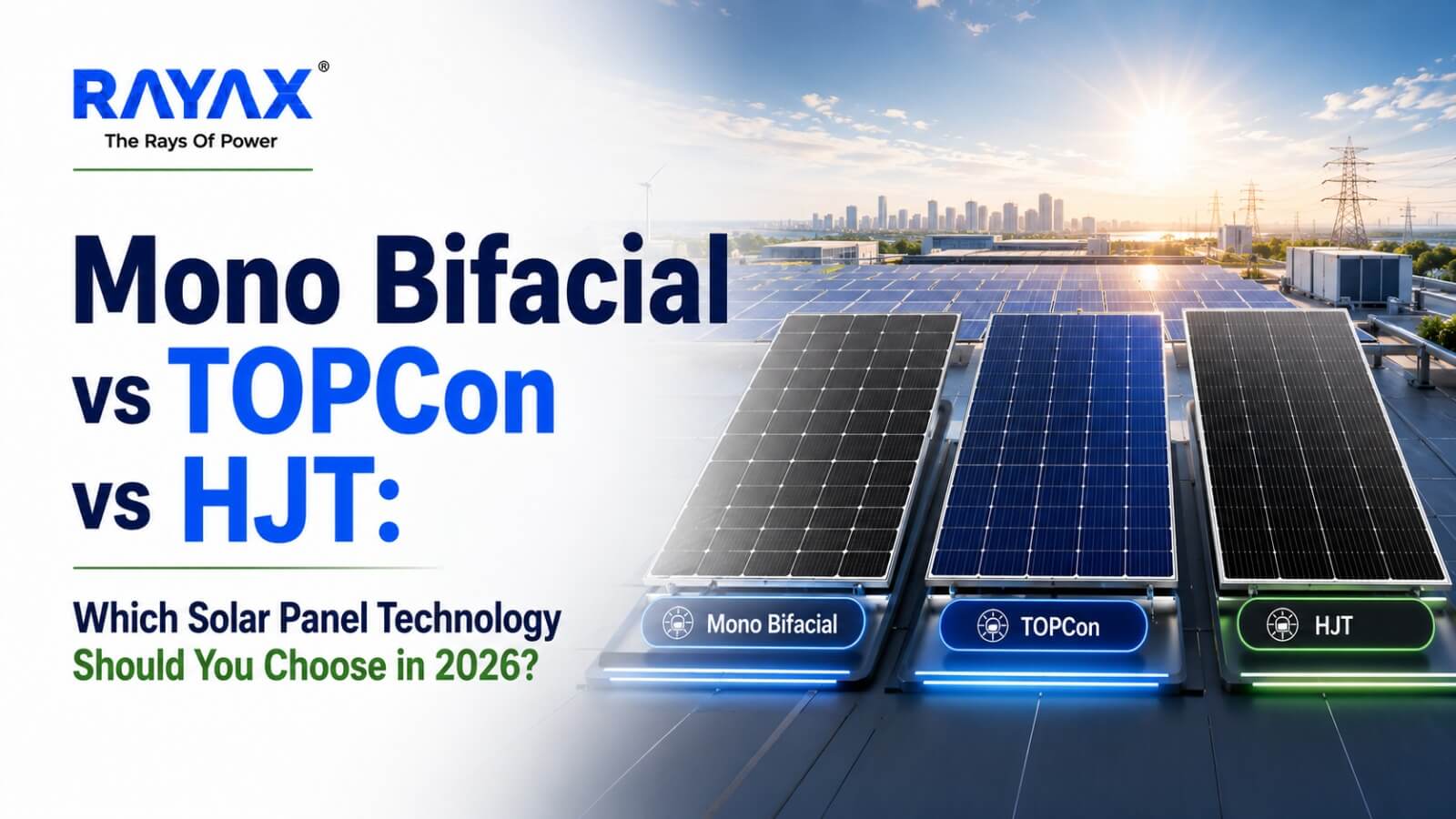
The field of solar energy has seen many technological advancements in the past few years. It's not always the case that mono crystalline panels are considered. With technological advancements, panels such as Mono Bifacial, TOPCon (Tunnel Oxide Passivated Contact), and HJT (Heterojunction Technology) are setting new standards in efficiency and energy generation.
But with all these options at hand, selecting the best technology may seem daunting to anyone.
There isn't any technology that reigns supreme. Every technology has its advantages and hence is suited for specific situations.
Why Solar Panel Technology Matters
The solar power system is intended to work effectively for more than 25 years, and although installation quality and design matters a lot, solar panels have the main impact on the amount of electricity produced by the system.
Using the appropriate technology will allow you to:
- Produce more electricity per unit area
- Perform well under conditions of low sunshine and high temperature
- Avoid significant degradation over time
- Maximise the return on your investment
- Future-proof your solar installation
It is not enough to care about the cost of the solar panels when buying them; one should also consider the performance of the solar panel technology over the decades.
Understanding Mono Bifacial Solar Panels
Mono Bifacial panels are one of the most popular technologies used for commercial and utility-scale solar projects currently.
As opposed to the traditional panels which collect sunlight from the front side, bifacial panels produce electricity not only from the front but from the rear side as well. The rear side collects the sunlight which is reflected from various surfaces such as concrete, sand, white roof tops or ground coverings designed specifically for reflecting the sunlight.
This extra generation of electricity could greatly increase the total yield of the solar facility if the proper installation is done.
Among the benefits of Mono Bifacial panels are:
- Increased generation due to double-sided electricity production
- Better performance in open installations on reflective surfaces
- High efficiency as compared to traditional monocrystalline panels
- Long service life and reliable operation
But the full benefit of the bifacial technology could be achieved only through the proper installation of the solar facilities. Such factors as the height of the panels, mounting, spacing, and ground reflectivity have a huge impact on maximising the rear side electricity production.
Mono Bifacial panels are highly preferred for utility-scale solar farms, industrial projects and PM-KUSUM installations because they give more energy generation without extra land usage.
Understanding TOPCon Solar Panels
The Tunnel Oxide Passivated Contact or TOPCon technology is widely recognised as the next big thing in crystalline silicon solar cells.
It uses the monocrystalline technology and adds an ultra-thin tunnel oxide film and a passivated contact layer. Although the technological aspects of the TOPCon seem highly complicated, the benefits of using such technology are rather simple.
Using the TOPCon panels means more sunlight is converted into electricity and less power losses occur inside the cell.
Therefore, the TOPCon panels are known to provide:
- Higher efficiency
- Better performance in weak light
- Higher efficiency in mornings, evenings, and cloudy days
- Higher efficiency at low degradation rates
- Higher efficiency at high temperatures
All of the above advantages of the TOPCon panels make it very beneficial to use them for commercial and industrial rooftop projects, where space is limited and each extra kW is valuable.
Under the Indian climate conditions with temperatures rising up to 40°C during summer, the TOPCon panels outperform most other technologies.
Understanding HJT Solar Panels
Heterojunction Technology, or more popularly referred to as HJT, utilises crystalline silicon and thin film technology to manufacture what is currently considered as one of the most advanced solar cells.
HJT modules are famous for their extremely efficient power production capabilities and great temperature characteristics.
Contrary to conventional solar cells, HJT technology decreases energy losses and enhances electrical charge transportation within the module.
Among the most prominent advantages are:
- Superb conversion efficiency
- Great temperature performance
- Excellent power output at low light conditions
- Minimal degradation
- Superior lifetime
Due to their outstanding properties, HJT modules have become more popular in top-class residential installations, commercial rooftops and special industrial applications where efficiency takes precedence.
On the other hand, HJT modules are typically more costly compared to Mono Bifacial and TOPCon solar modules because of the complex manufacturing process.
In installations where budget is a serious issue, spending extra money on these kinds of modules does not guarantee better economic results.
Efficiency: Which Technology Performs Better?
The efficiency of solar panels represents the ratio of sunlight which can be transformed into energy.
At the moment, HJT panels demonstrate the best performance in terms of efficiency rates, followed by TOPCon panels. The third group includes Mono Bifacial panels which show a great performance level especially at places where the rear side of the panel can be used for generating energy.
Nevertheless, efficiency rate should not be the only factor influencing your choice.
Sometimes, the panels with low efficiency installed in appropriate conditions produce much more energy than panels with high efficiency installed improperly.
This emphasises the significance of appropriate engineering.
Performance in Indian Weather Conditions
There is a variation in climate across India, including the hot summer season, monsoons, and dusty climate.
The above climatic conditions impact the efficiency of solar panels.
The TOPCon and HJT technologies work well in hot climatic conditions due to low temperature coefficients whereby efficiency loss occurs less in rising temperatures.
Mono Bifacial works excellently especially in utility-scale projects where the sun rays get reflected thereby increasing energy output.
Bifacial technology would be beneficial for the projects that exist in Rajasthan, Gujarat, Madhya Pradesh, and other areas with enough sunlight.
Durability and Long-Term Reliability
Solar panels are designed to function well for decades.
Although all three technologies are highly durable, TOPCon and HJT panels tend to degrade less annually than many standard solar panels.
This implies that after 20 or 25 years, they can still generate electricity at a higher efficiency rate than most other solar panels.
From a business perspective, this is an important consideration since a small improvement in annual performance translates into additional electricity generated during the period the business is running.
Which Technology Should You Choose in 2026?
Ultimately, everything depends on the goals of your projects.
In case you need to install a utility solar plant or a PM-KUSUM installation, Mono Bifacial panels may be an amazing choice because they increase the amount of electricity produced due to capturing rear side sun rays.
In case there is not much space on the roof and you want to make the most efficient use of it, then TOPCon panels will be your perfect choice.
But if your goal is to install one of the most innovative and efficient technologies available now, then HJT panels will be an ideal choice for you.
Rather than asking what is the best technology, you need to ask yourself what is the best technology for you.
Choosing the Right Technology Is More Than Choosing the Right Panel
One misconception about a solar project is that the selection of the best solar panel automatically ensures the success of the project.
In fact, technology in solar panels forms just one component of the whole process.
Feasibility of the site, engineering of the system, choice of inverters, mountings, commissioning, and even the maintenance play a key role in ensuring that a solar power plant succeeds.
No matter how technologically superior a solar panel is, it will be of no help if the planning and installation phases are not done well.
This is why the involvement of an experienced EPC partner becomes as important as choosing the best panel technology.
Why Rayax Energy?
Every project at Rayax Energy starts with knowing what the customer wants from us rather than suggesting any one particular technology.
This could be for the installation of solar panels on roofs for businesses, industrial solar projects, or even large scale PM-KUSUM projects, but the emphasis is always on creating systems which will provide them good value and performance.
Rayax Energy ensures all this through comprehensive feasibility analysis, superior engineering design, proper technology selection and implementation of the project.
Conclusion
Solar energy technology is growing very fast, and some of the current advanced solar technologies include Mono Bifacial, TOPCon, and HJT.
Each of these technologies has its unique qualities. While Mono Bifacial PV panels provide the best energy generation capacity, TOPCon is known to provide excellent efficiency and cost value. HJT is currently the most advanced technology used to generate solar energy.
While trying to use new solar energy technology is not wrong, a better option would be to choose the one that suits your energy project.
With a proper technology and good EPC provider, your solar energy source will keep providing you with clean and cheap energy for many years to come.