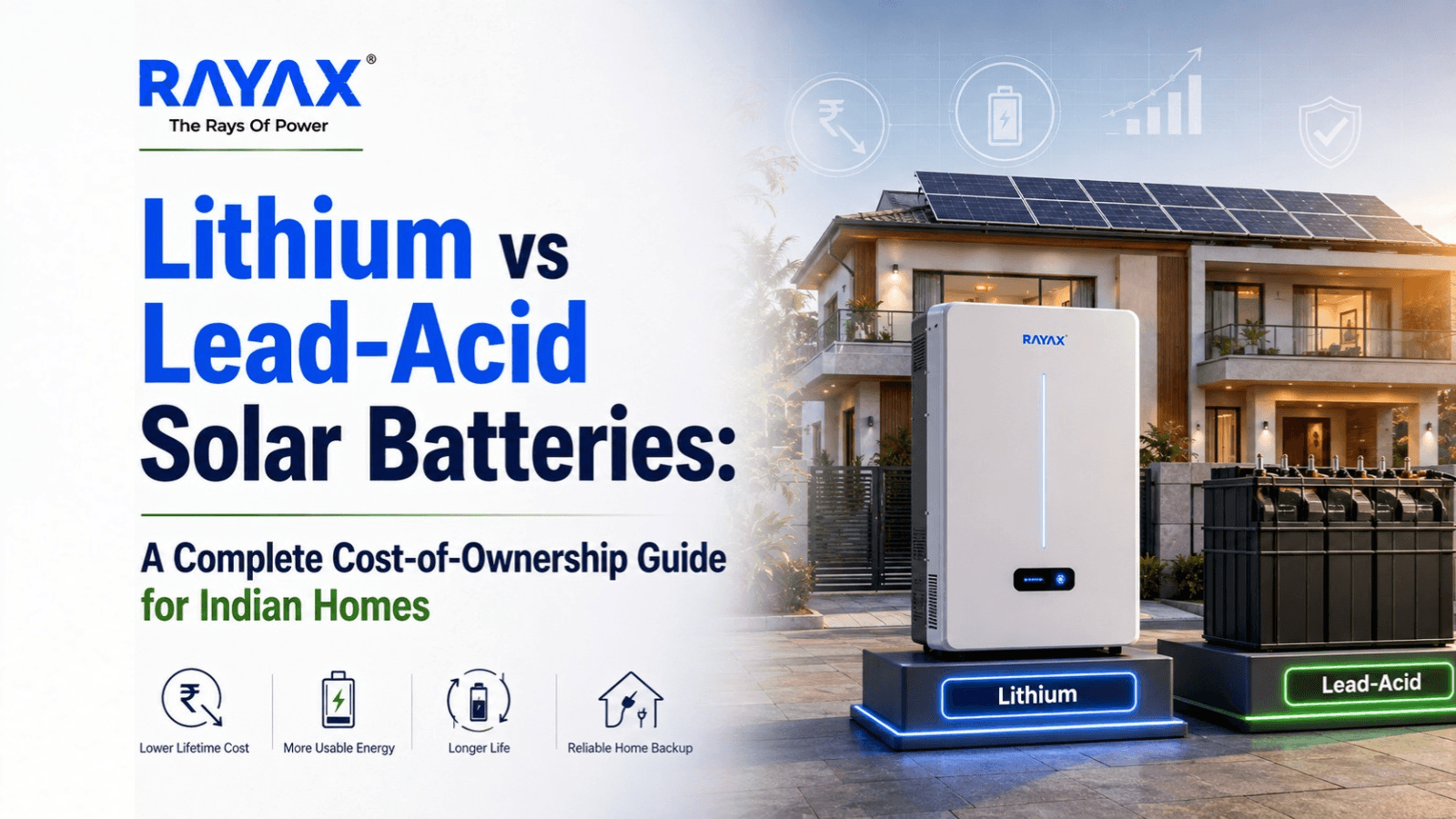
With growing numbers of Indians going for solar roof systems, it's time that discussions about solar panels have gone beyond that. One discussion that is taking its place equally now includes:
“What is the best solar battery to opt for?”
A battery is crucial to determine how well electricity can be stored from the system during the day and used when it's not available due to lack of sunshine or power outage. Even with a number of battery options available in the market, lithium-ion and lead-acid batteries still rule the domestic solar sector.
Initially, a lot of people consider opting for lead-acid batteries purely because of their low cost, whereas others favor lithium batteries because of their technology. But considering the purchase cost does not reveal everything.
The better approach would be analysing the batteries on the basis of the overall cost of ownership, which includes everything from initial costs to replacement costs, efficiency, and longevity of the batteries.
Why Solar Batteries Matter
A solar battery enables you to store extra electrical energy generated by your rooftop solar system for usage at a later time rather than relying solely on electricity supplied from the grid.
For houses in India, batteries offer a number of benefits such as:
- Alternative source of power when there is no electricity supply.
- Increased efficiency of solar energy.
- Decrease in dependency on grid-supplied electricity.
- Increased self-reliance regarding energy.
- Long-term cost-effectiveness.
But the type of battery that you select will influence your system greatly in the coming years.
Understanding Lead-Acid Solar Batteries
These kinds of batteries have been in use for several years now and are considered one of the most recognised battery types in India.
They are mostly placed in residential homes due to their low cost and easy accessibility.
There are various types of lead-acid batteries, which include flooded batteries and other types like AGM and Gel batteries.
Advantages of Lead-Acid Batteries
Lead-acid batteries have retained their appeal among homeowners due to the following advantages:
- Less initial cost
- Tried and tested technology
- Wide availability in India
- Suitability with many solar power setups
- Familiar maintenance process
Among homeowners with small budget constraints, lead-acid batteries are generally considered a cheaper entry point.
Limitations of Lead-Acid Batteries
Although lead acid batteries may appear cheap upfront, there are many drawbacks to them in terms of their long-term worth.
Some of these drawbacks are:
- Shorter lifespan
- Less efficient charging
- Slower charging speeds
- Maintenance needs (for flooded types)
- Reduced efficiency when deep discharged often
- Heavy and bulky
Understanding Lithium Solar Batteries
With the increasing use of solar energy, lithium-ion batteries have gained popularity among residential, commercial, and industrial sectors.
Despite their higher initial costs, they provide many benefits that can convince one to use them in a house.
Advantages of Lithium Batteries
Some of the advantages associated with lithium batteries include the following:
- Longer life span
- Efficient charging and discharging process
- Fast charging process
- Minimum maintenance needs
- Small and lightweight
- Good performance in frequent cycling
- Greater battery capacity
Unlike lead acid batteries, lithium batteries do not lose much of their life even when they are fully drained.
This allows the homeowners to utilise most of the energy stored in the battery each day.
Limitations of Lithium Batteries
Lithium-ion batteries do have their limitations. Some of which are:
- Higher price tag when buying new
- Require good Battery Management System (BMS)
- Their effectiveness is reliant on choosing reliable manufacturers
- Installation is best done by professionals
Yet many property owners feel the initial costs are worthwhile.
Looking Beyond the Purchase Price
When one compares battery technologies, it is tempting to think of the payment made on the day of installation alone. Solar energy is, however, an investment in the long term.
The battery one buys now could be part of his energy needs in the coming years. It is here that the total cost of ownership comes in handy.
One shouldn't ask, "Which battery is less expensive now?"
Rather, "Which battery is going to be less expensive over the next ten years?”
Lifespan Makes a Significant Difference
One of the largest distinctions between lithium and lead-acid batteries is the longevity that they both have.
It is known that lead-acid batteries will not last long since they will survive less of the charge-discharge cycles.
Lithium batteries are made to work for a much longer time because they will be able to go through much more cycles of charge and discharge.
This means that the owner of such a house will have to change his lead-acid batteries several times while using only one lithium battery.
Efficiency Affects Everyday Savings
All the units of energy stored in the battery are not usable. They all face the problem of energy loss during charging and discharging cycles.
The lithium batteries have far greater efficiency levels compared to lead-acid batteries. Therefore, a greater amount of energy obtained through solar power is converted into usable energy.
In the long run, such efficiency will help save electricity bills.
Maintenance Requirements
The field of maintenance is also one where there is a big difference between these energy sources.
Lead acid batteries usually demand regular checking and maintenance for them to perform well.
According to different types of batteries, people should check the electrolyte levels in the batteries, clean up their terminals, and ensure that they are well ventilated.
However, lithium batteries do not demand much maintenance.
This is another benefit that busy families can derive from these batteries.
Space and Installation
Battery size is frequently ignored when planning. Lead acid batteries tend to be bigger and heavier, hence taking more installation space.
Whereas, lithium batteries have comparable or even higher capacity but take less space.
This makes them a better choice for installations in modern homes which might have little space.
Which Battery Is Better for Indian Homes?
It all depends on your preferences. If you need a lead-acid battery, then:
- You have budget constraints
- The need for backup is intermittent
- Periodic maintenance does not bother you
- Lower initial cost is your top priority
If you want to opt for a lithium battery, then:
- You want something more permanent
- Maintenance-free battery is what you want
- The battery needs to be used on a daily basis
- Space is an issue
- Efficiency is a concern
- Fewer replacements in the future is preferable
No single choice is perfect for everyone.
The battery is one that suits your energy consumption pattern and budget at home.
Why Proper System Design Matters
The choice of the appropriate battery is just one of the considerations for building an effective solar system.
Compatibility of the size of the battery, the inverter, energy consumption by the household, back-up needs, and anticipated energy needs must be synchronised.
An oversized battery could make the project expensive without need.
Whereas, an undersized battery could not offer adequate back-up when needed most.
This explains why a proper energy audit is necessary for any domestic solar system project rather than just equipment selection according to specs or advertisements.
How Rayax Energy Helps Homeowners Make the Right Choice
Every solar solution provided at Rayax Energy is customised to meet the client's energy demands.
Unlike some solutions that recommend just one kind of battery for all their installations, we assess the factors like electricity use, backup needs, available room, budget, and future goals before providing the best suggestion.
If you have just installed a solar system on your roof or are planning to do so, making the right choice about the battery can make all the difference.
Conclusion
Lithium-ion and lead-acid batteries are two types of batteries that find application in the present-day residential solar industry.
The use of lead-acid batteries remains one of the cheap options for those homeowners who wish to minimise their investments at the time of installing their solar energy system.
On the other hand, lithium-ion batteries are characterised by high efficiency, longer lifespan, reduced maintenance, and high performance in the long run.
Thus, while purchasing a battery, do not focus only on its cost but take into account such factors as maintenance, longevity, efficiency, and others in order to estimate the total cost of the product.
As the solar panel installation will work for years, the selection of the proper type of battery will be among the most crucial decisions that you have to make.